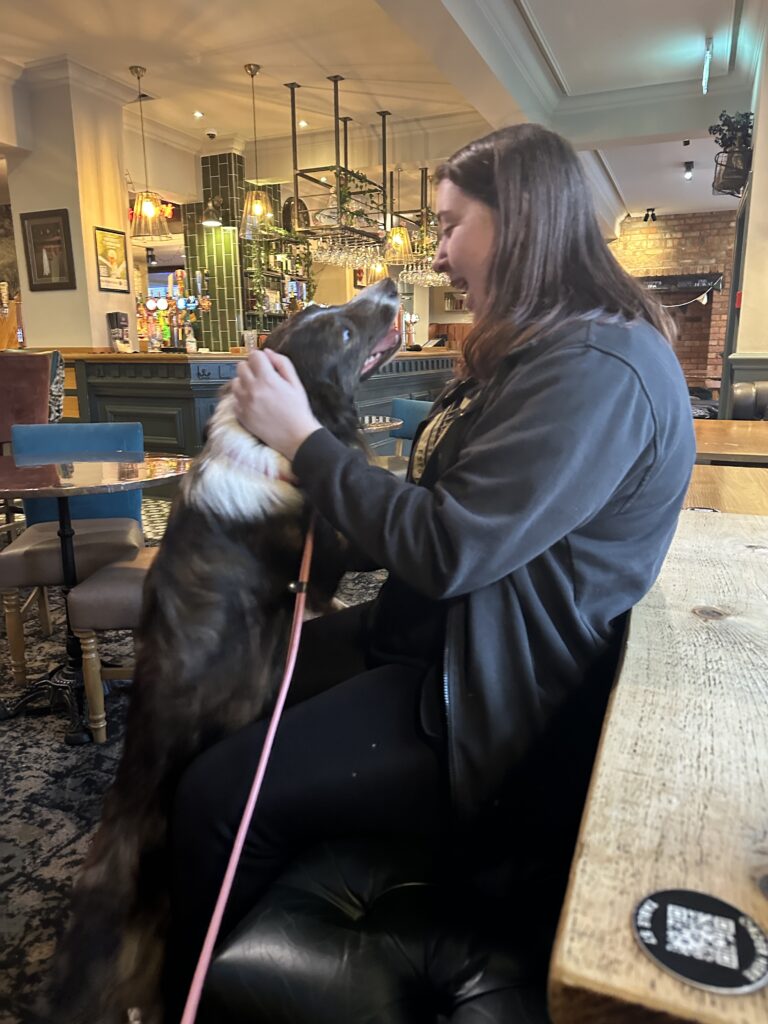
How frustrating is it when we have been out for a walk with our dogs, especially when the weather conditions are like they are right now, and a friendly stranger smiles at them. Before you know it your dog plants two muddy front paws on their nice clean clothes.
Your dog isn’t trying to embarrass you.
Let’s look at what is actually going on in your dog’s brain.
From puppyhood, humans have often meant cuddles and attention. Puppies quickly learn that human = rewarding experience. If jumping up gets that contact quicker, and that contact is repeated, the brain strengthens the wiring for that behaviour.
Fast forward to now. Your dog sees a friendly stranger look at them. Dogs are experts at reading human facial expressions and focus on the eyes. The brain predicts a reward. Dopamine, part of the brain’s reward system, is released in anticipation. Once the brain learns that something predicts a reward, dopamine is released before it even happens. That anticipation drives behaviour.
So the muddy paws land. The person pushes the dog away, makes eye contact and says no. To a human that feels like rejection, but to your dog the brain registers social engagement. There was eye contact, voice, touch, movement. The prediction is confirmed. Dopamine strengthens the neural connections involved in the jump.
The stronger those pathways become, the faster anticipation builds next time. Arousal rises. Noradrenaline increases attention and strengthens memory formation. High arousal plus confirmed social contact makes the behaviour more likely to happen again.
So what can we do?
Think of neural pathways as paths in the wood. The more often they are walked, the clearer and faster they become. If a new, well laid path appears that gets you to your destination just as quickly, you will use that instead. Jumping is the original path. We need to make a new path clearer and more desirable.
To do this we need a two pronged approach. Firstly, teach a new behaviour such as popping your dog in middle as someone approaches, or teaching a nose touch. Reward the new sequence: person approaches – dog goes into middle – reward. The prediction shifts. The dog anticipates reward for the new behaviour instead, and that path becomes stronger.
Simultaneously we must prevent rehearsal of jumping. If it is not practised, the neural path weakens over time.
If the dog jumps just once and it is reinforced again, because the original pathway is already strong and efficient, even that one reinforcement can strengthen it disproportionately compared to the weaker new pathway you are trying to build.
Think of it like a motorway and an A-road. If roadworks close the motorway and there is an A-road that is almost as quick, you will switch. But as soon as the motorway opens again, you go back to it. Strong, well used pathways are easy for the brain to return to.
Change the behaviour and you change the pathway. Practice makes permanent.
Post your Comment About This Product