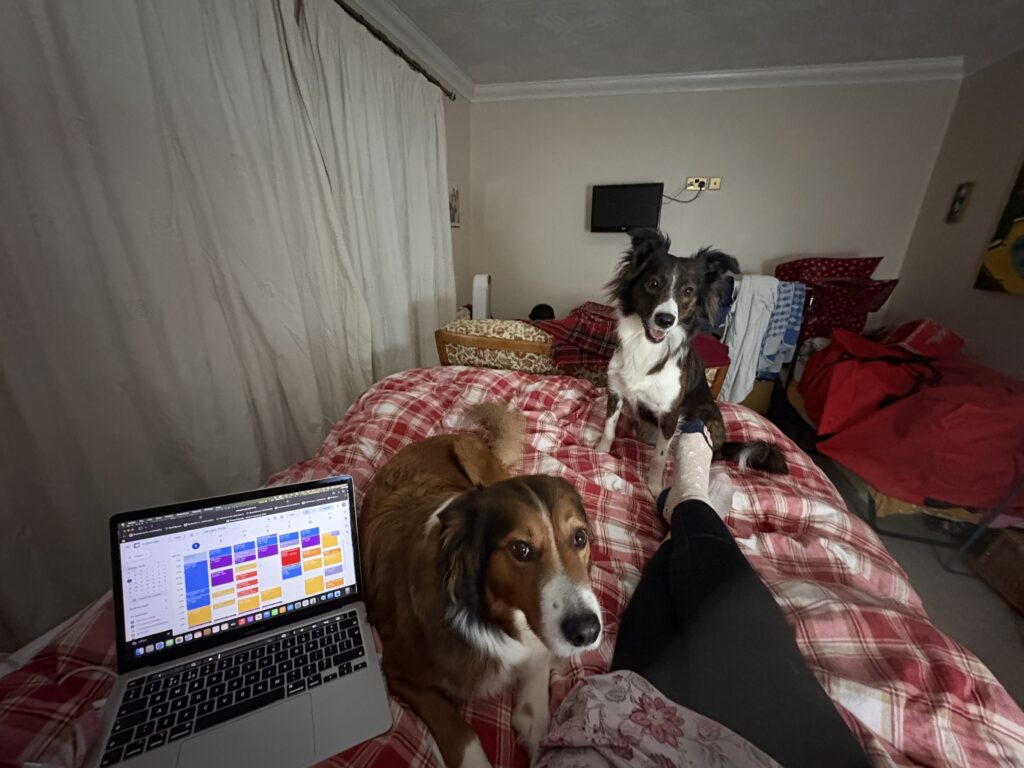
Life has a funny way of reminding us that we are not really in control of much at all. This week has been a perfect example of why raising flexible dogs matters so much, because life can change shape with no warning at all.
One minute everything is ticking along nicely, the dogs have their routines, we have our routines, and we assume tomorrow will look very similar to today. And then suddenly it does not. It only takes one phone call, one illness, one unexpected situation, and the whole week, sometimes the whole year, can change shape overnight.
That is exactly what has happened for me this week. I ended up taking my mum into hospital, my dad has only just come out of hospital himself, and I am now staying at my mum and dad’s place to keep everything running smoothly and to look after my mum’s elderly cousin. None of this was planned. None of this was even on my radar 48 hours ago. But here we are.
And do you know who is taking it all brilliantly
The dogs.
They do not know why we are in a different house or why the routine has flipped upside down, but they are settling beautifully beside me as if this was the plan all along. They just get on with it, and that makes a world of difference when everything else feels a bit chaotic.
This is exactly why I spend so much time helping people raise flexible dogs. Not perfect dogs. Not robotic dogs. Dogs who can cope when life changes, because life will change.
Why flexibility matters more than we think
We all like to believe life is stable, but if the last few years have taught us anything, it is that nothing stays the same. One day you are living in the home you think you will be in forever, and the next you are isolating during Covid, or moving house, or dealing with a family emergency, or changing jobs, or suddenly needing to stay somewhere completely new.
In the 10 to 15 years of a dog’s life, the world can shift dramatically, and often does. We owe it to them, and to ourselves, to help them be flexible, and cope with those shifts.
Because when you are already trying to manage an emergency, the last thing you need is to worry that your dog cannot settle anywhere but home. It doubles the stress for you and for them.
Flexible dogs make hard times easier.
Inflexible dogs make hard times even harder.
This bit is controversial, but I am not a fan of routines for dogs
This will make some people raise an eyebrow, but here is the truth
I do not think rigid routines are good for dogs.
We humans love routines because they make us feel secure. But dogs do not need every part of their day mapped out, and in many cases, routines create dogs who really struggle when life suddenly changes.
My old horse, Crystal, taught me this long before I ever became a dog trainer.
I worked shifts, so I never visited her at fixed times. Morning could be anytime between half past five and eleven. Evenings were anywhere from two in the afternoon to midnight. She never knew exactly when I was coming, but she always knew I would come, and because of that, she did not spend her day clock watching or waiting anxiously at the gate.
In contrast, other horses on the yard who were fed and brought in at the exact same times every day would become stressed if their owner was even half an hour late. I will never forget one evening when someone had an accident and could not get there in time. Their horse was absolutely beside itself, stood at the gate for hours because the routine had changed and it did not know how to cope.
Crystal, meanwhile, was chilled and balanced because her life was not built on a timetable.
I genuinely believe the same is true for dogs.
Small, everyday changes create big flexibility
Helping a dog become adaptable does not always mean big training plans. Sometimes it is the small changes that make the biggest difference.
Things like
- Not doing your dog’s routine in the same order every day
- Feeding within a two to three hour window instead of at an exact time
- Taking walks at different times
- Not always getting up at the same time
- If you work from home, waking up anywhere between half past six and half past eight
- Putting your dog to bed at slightly different times, even if your own bedtime stays the same
These small shifts teach your dog that life still carries on even when things happen in a different order. It builds emotional looseness. It prevents fixating. And it prepares them for bigger changes later on, like staying somewhere new or managing a sudden change in your circumstances.
These tiny adjustments make a dog far more resilient in the long run.
Giving puppies the best start
Puppies are primed to learn that the world is safe and varied. The more experiences they have early on, the more adaptable they become.
This does not need to be complicated
- Sleeping somewhere different
- Settling in a friend’s living room
- Experiencing different household noises
- Learning to switch off in new environments
- Travelling in the car
- Exploring new surfaces and smells
You are not building a busy puppy, you are building a capable one.
Let us talk about crate training, honestly
Crates split opinions, but here is how I use them.
I rarely crate my dogs at home now, they do not need it. They are calm, trustworthy, and able to settle. But I absolutely crate trained them as puppies, and it was one of the best things I ever did.
Crate training, used well, plays a big part in creating flexible dogs who can settle anywhere. teaching calmness, self control, switch off skills, and confidence in new environments.
They also give you the confidence to take your dog anywhere, hotels, friends’ houses, family homes, without worrying about toileting accidents, chewing, or overstimulation.
My dogs travel in crates in the van for safety, but here at my parents’ house they are not in crates at all. They are simply lying beside me, fast asleep, because those early lessons taught them how to settle anywhere.
That is the real value of crate training
It teaches dogs to cope when life is not predictable.
Adults benefit too, it is never too late
Older dogs can absolutely learn relaxation and flexibility. Consistent small changes, settle work, and practising calm in different places all help.
This week has proved the point perfectly
If my dogs struggled with change, this situation would be far more difficult. But because they can settle anywhere, I can deal with what actually needs my attention, rather than worrying about them as well.
Their flexibility has genuinely supported me at a time when everything else feels uncertain, and it has reminded me why flexible dogs make such a difference in real life.
That is what I want for owners, not dogs that never put a foot wrong, but dogs who can bend with life rather than break under it.
If you would like help building these skills
Just reach out. Whether you have got a new puppy, a teenager who is finding life a bit much, or an older dog who needs help learning to relax, I can guide you through it.
If you need support, you know where I am.
Leave a Reply